Thinking on your feet is a skill. Train it.
ThinkProv is a daily training app for the moment you are put on the spot. Short spoken reps, honest AI feedback, and a short daily program that adapts to how you actually speak.
You know what you think. Until someone asks.
These are the answers people give when the app asks what brought them here. None of them is about knowing too little. They are about getting what you know out, in order, while someone is waiting.
- ThinkProvWhat brought you here?I lose my train of thought.
- ThinkProvWhat brought you here?People look confused.
- ThinkProvWhat brought you here?My words come out jumbled.
- ThinkProvWhat brought you here?I over-explain.
You have two thinking systems.
One is fast and automatic. One is slow and deliberate. Speaking well under pressure means moving work from the second to the first.
Reading puts a move in System 2. Only producing it under time pressure, again and again, moves it to System 1. That is why ThinkProv is built on reps you say out loud, not lessons you watch.


 Reframe Challenge, So What Ladder, Mental Models, Framework Drill


 Word Association, Don't Say It, Hot Seat, Concept Bridge
Trains how you think, then puts it under pressure.
Four layers, one daily rep. There is no fixed curriculum. The program adapts every day to your recent reps.
- Map your thinkingA few short spoken answers on day one set your baseline and a first reading of how you think.
- A short program, every dayTwo drills, a short read and one Cold Stage, chosen fresh from your recent reps.
- DrillsEight of them, each built for one skill. Four make a move automatic. Four build the move in the first place.
- Cold StageA topic, a moment to think, then you speak. No script.
- The reportThinking and delivery, scored apart. One thing to sharpen, with a better version of what you said.
- ProgressBaseline against now. What moved, what slipped, and a map of the ideas you have spoken about.
 Systems thinking1 of 4 done
App screen with sample data.
Eight drills. Each one sharpens one thing.
In the app you swipe through them as a deck, with today's focus lifted to the front. Every card says what it trains.
System 1: make it automatic
Six thinking styles. You already use one.
Your first answers are read for the style you reached for: analytical, in stories, persuasive, by asking questions, in systems, or creative.
You think in stories. Technology runs on thinking analytically.
We add it on to how you already think. Then the other styles, one at a time, on the way to Holistic thinker: all six, each used where it fits.
An example of the reveal after the baseline. Training adds a style. It never replaces yours.
Thinking and delivery, scored apart.
Ten dimensions, five for what you said and five for how it sounded, so you always know which half to work on.
- One thing to sharpen, with what you said and a better version of it.
- Thinking and delivery each get their own view, with their own score.
- Every report is labelled AI-generated, and every part of it can be rated.
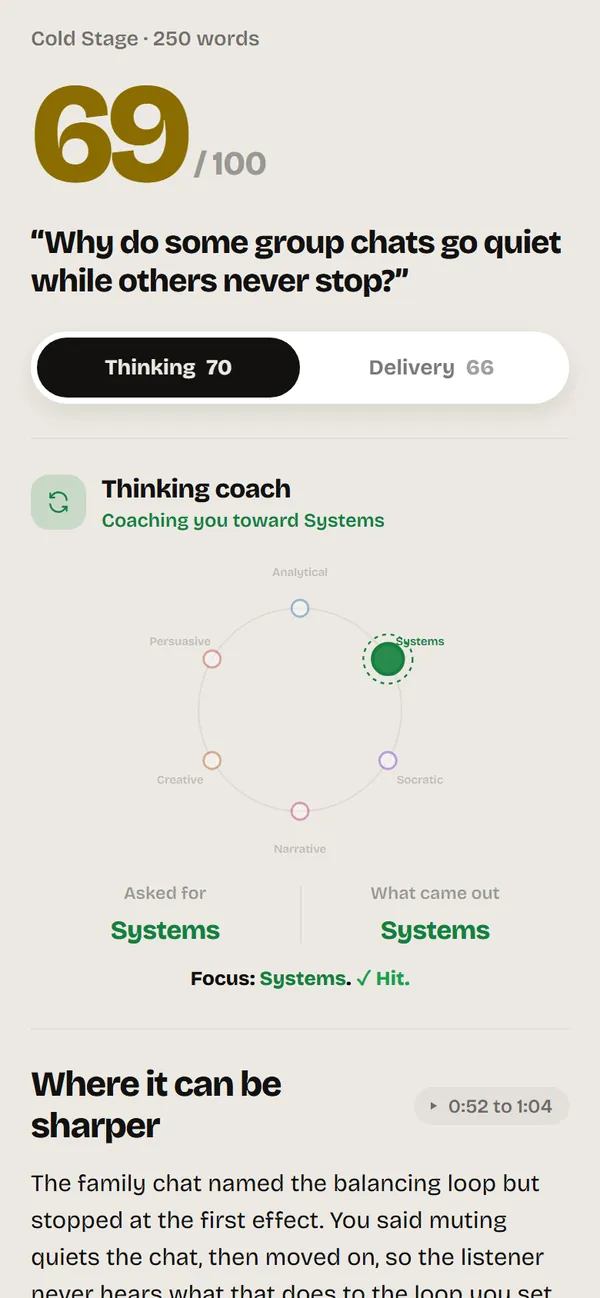
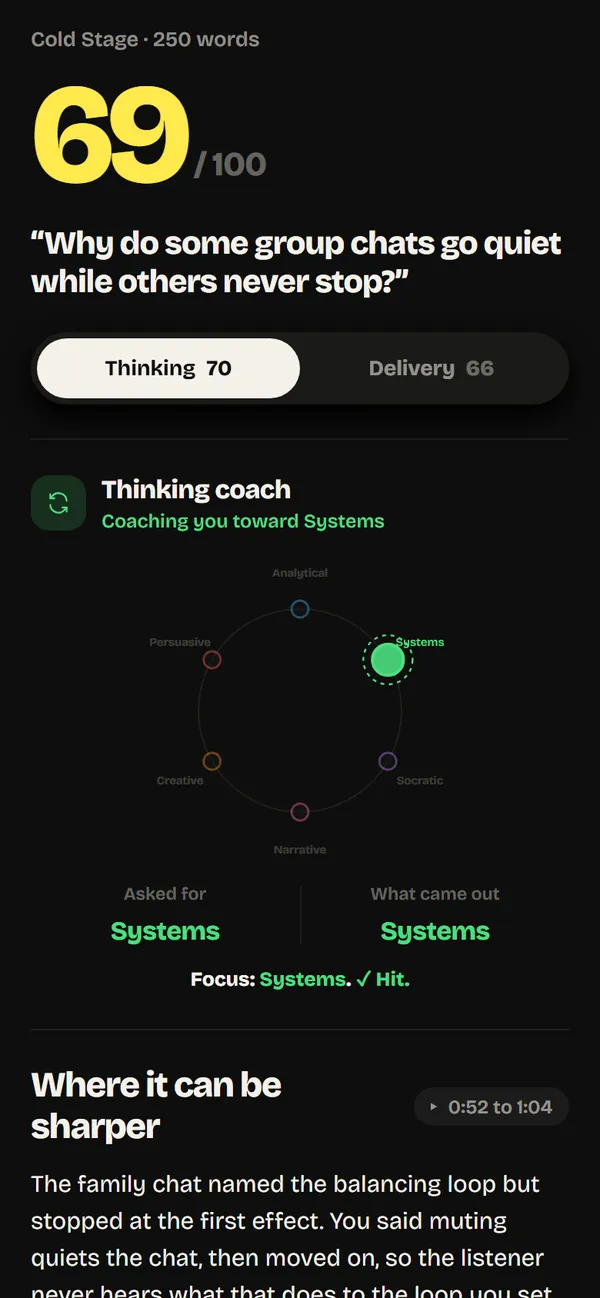
App screen with sample data.
Same prompt. Same clock. See how they do.
Pick a fast drill, play it, then send the exact round. Your friend plays it in the browser with no app, and their score flies back onto your Home.
- Four drills to choose from: Word Association, Don't Say It, Hot Seat, Concept Bridge.
- Your friend gets the same prompt and the same clock you had.
- Only what you said in that one round travels with the link.
The thinking behind ThinkProv.
One rep a day. Not an hour.
A short daily program that adapts to how your recent reps went.